

Key Takeaways
- Most identity theft recovery takes months, and victims who act in the first 24 to 48 hours suffer the least damage
- A simple family document binder system can cut your emergency response time from days to minutes
- Children need their own document binders too, and most families forget this
- A separate legal binder for power of attorney, healthcare directives, and will or trust documents protects your family in any emergency, not just identity theft
- Nearly 7 in 10 American adults do not have a will, the most basic legal document a family needs
In This Guide
Most families have everything a scammer needs scattered across drawers, email inboxes, and three different filing cabinets. A family document binder is the simple Sunday system that changes that.
Why Document Chaos Is the Scammer’s Best Friend
When something goes wrong with your identity, the clock starts immediately. According to the Federal Trade Commission, identity theft victims who act within the first 24 to 48 hours significantly reduce the damage scammers can do. The problem is that most families lose those first critical hours just trying to find their own paperwork, which is exactly the problem a family document binder is designed to solve.
Think about your own home for a minute. If a scammer opened a credit card in your name this morning, could you put your hands on your Social Security card, your driver’s license number, your list of bank and credit card accounts, and your children’s birth certificates in under five minutes? For most families, the honest answer is no.
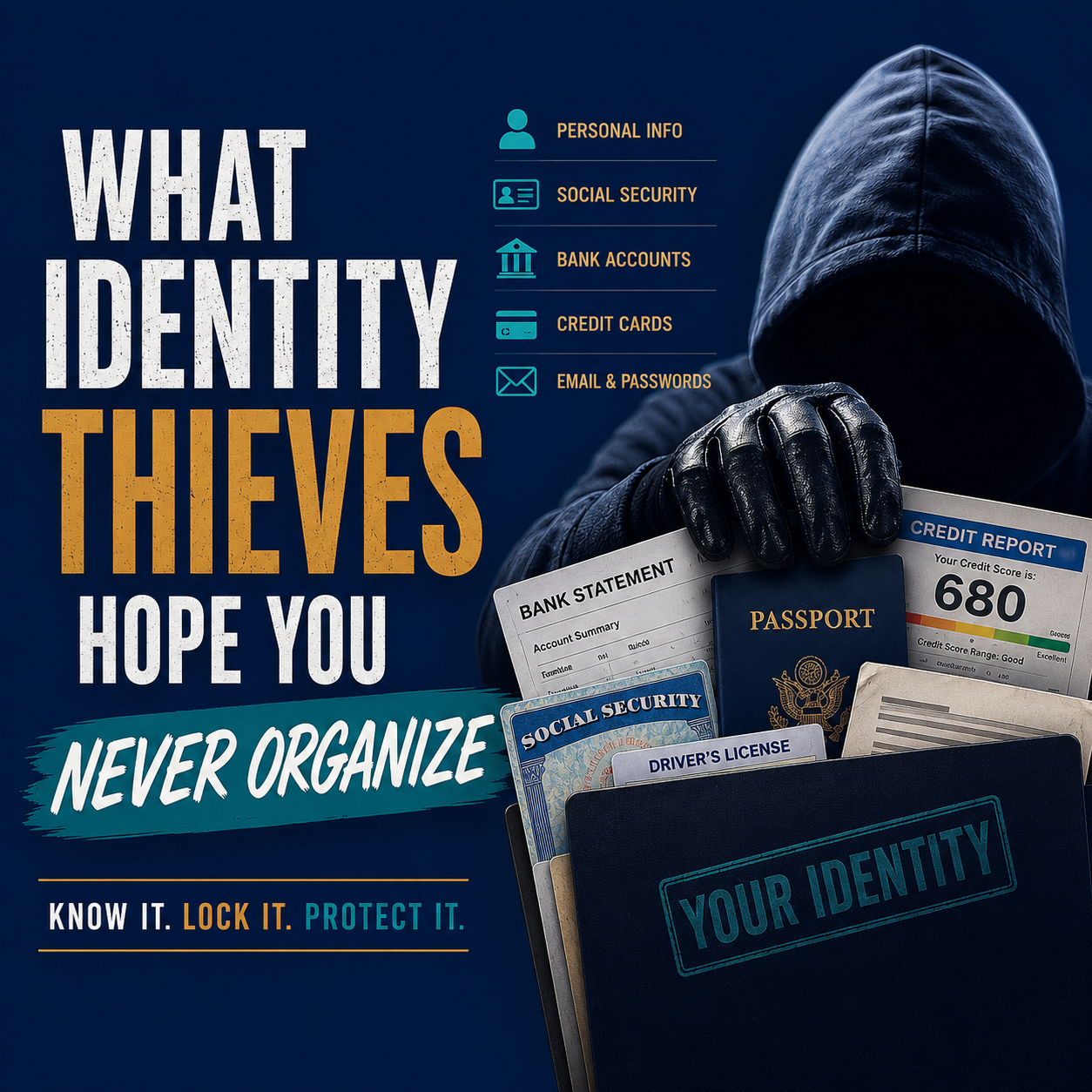
That is the gap identity thieves count on. Not your weak password. Not your overshared social media post. Your disorganization.
The Seven Things You Should Be Able to Find in Under Two Minutes
These are the documents you need access to during an identity emergency. The originals should live in the binder. Two exceptions are worth noting. A copy of your driver’s license is fine because you carry the original with you. And for your passport, keep the original in the binder pocket but also keep a paper copy inside the binder, so that someone at home can read your passport number to you if it is ever lost or stolen while traveling.
For every adult in your household:
- Social Security card
- Driver’s license or state ID
- Birth certificate
- Passport
- Vehicle titles
- Most recent tax return
- A current list of every credit card and bank account, with the customer service number for each
If you just read that list and felt your stomach drop, you are not alone. Most families have these items spread across at least four different locations. Some of them could even be stored in the cloud somewhere with a password that no one can remember.
A printable version of this list, with space to write where each document lives in your home, is available in our free Identity Theft Protection Checklist. Print it, slide it into the front of your first binder, and check off as you go.
The Three Things Almost Nobody Organizes Until It Is Too Late
Here is where most identity protection advice stops. These three items are the ones I see families overlook again and again, and they are exactly what scammers love.
Your children’s documents. Children are targeted for identity theft more often than people realize because their credit files are clean and unmonitored. A child’s stolen Social Security number can be used for years before anyone notices, usually when the child turns 18 and applies for their first credit card or student loan. Every child in your home needs their own organized set of records.
Vaccination and medical records. Medical identity theft is one of the fastest growing categories of fraud. If someone uses your insurance or your child’s insurance to receive care, you need original records to prove what care was actually yours. This becomes critical if a fraudulent medical bill shows up in collections.
Records for family members who have passed away. Identity theft of the deceased, sometimes called ghosting, is one of the most underreported forms of fraud in this country. The most comprehensive study on it, conducted by ID Analytics and frequently cited by AARP, found that the identities of approximately 2.5 million deceased Americans are used fraudulently each year, with about 800,000 of those representing deliberately targeted attacks rather than random use of Social Security numbers.
Here is the part you need to know. That study is from 2012, and no major organization has updated those specific numbers since. The reason is not that the problem went away. The reason is that ghosting is uniquely hard to measure. The victim cannot file a report. Surviving family members often do not discover the fraud until tax season, debt collection notices, or estate settlement weeks or months after the death. Many cases are never connected to the original deceased person at all.
What we do know is that the conditions that enable ghosting have gotten worse, not better, since that study was published. Obituaries are now publicly searchable online, including the deceased person’s date of birth, hometown, employer, surviving relatives, and sometimes the funeral home and date of services. Stolen Social Security numbers are widely available for sale on the dark web, often for just a few dollars apiece, because so many data breaches have flooded the market. The Social Security Administration’s Death Master File contains more than 85 million death records dating back to 1936, and there is a gap of weeks to months between when a person dies and when financial institutions, credit bureaus, and government agencies actually update their records.
That gap is the window thieves work in. Obituaries get watched. Mail gets redirected. Credit cards get opened and fraudulent tax returns get filed. By the time a grieving family notices, the damage is done and the trail is cold.
What to do if you are handling affairs after a death
If you are the executor or family member handling affairs after a death, you need three things organized and easy to find. Certified death certificates. The deceased person’s last tax return. And a written list of every account they had, with login or contact information for each.
Order at least three certified copies of the death certificate to start. They typically cost $25 to $50 each, so you do not need to overbuy. Most banks and government agencies will accept a copy of the original. If you need more later, you can usually order them from the vital records office within a day or two.
Notify the Social Security Administration directly even if the funeral home says they will handle it, by calling 800-772-1213. Notify the three credit bureaus directly that the person has died. Send each bureau a letter by certified mail with a copy of the death certificate, the deceased person’s full legal name, last known address, Social Security number, and date of birth. They will add a “deceased, do not issue credit” notation to the file, which blocks new accounts from being opened in that person’s name.
Be careful what details go into the obituary itself, especially exact date of birth and hometown, which are exactly what thieves need to assemble a fraudulent identity.
This is not a small issue, and it is the kind of crime that ambushes families when they are least able to fight back. A family document binder system makes that fight winnable.
How I Organized Our Family in One Afternoon
I want to share exactly what I did, because the solution is simpler than most people expect.
I went to Staples and bought heavy-duty view binders, the kind with a clear plastic sleeve on the front and spine so you can slide in a custom cover page, and a plastic pocket inside the front cover for items like passports.
Building the family document binder for each person
Then I made a binder for each member of our family. Mine. My husband’s. And one for each of our children.
Inside each binder I put the original documents that person needs to have organized in one place. Social Security card, birth certificate, immunization records, vehicle title if they have one, death certificates for family members where relevant. The driver’s license is the one exception, because you carry that with you, so I keep a copy of it in the binder instead. The plastic front pocket holds the passport itself. I also keep a paper copy of the passport inside the binder, and here is why. If you are traveling and your passport is lost or stolen, a family member or trusted friend at home can open the binder, find the copy, and read your passport number to you in two minutes. That information is what the embassy will ask for first when you start the replacement process. The clear cover lets me label each binder clearly without confusion.
I also used page protectors for the larger documents like vehicle titles, and I bought the larger envelope-style pages that snap into a three-ring binder. The envelopes are where I put anything thicker, like a list of our insurance policies clipped together with copies of each policy’s cover sheet.
One more thing I do every year. When I pull my free credit report from AnnualCreditReport.com, I print a copy and put it in my binder. It serves two purposes. It gives me a paper record of what my credit file looked like at that point in time, which is incredibly useful if I ever need to dispute fraudulent activity. And it forces me to actually look at the report once a year, which most people never do.
The legal binder most families never build
After the personal binders were done, I made one more. This is the binder I want you to pay close attention to, because most families never make this one and it matters more than any of the others.
The legal binder holds our power of attorney documents, our healthcare power of attorney, and a thumb drive containing our trust documents and our will. Everything a family member would need to act on our behalf in a medical emergency, a financial emergency, or after a death is in that one binder.
Think about what that means. If something happens to me tomorrow, my husband does not have to call an attorney to find out where the trust paperwork is. If something happens to both of us, our trustee opens one binder and has everything. No scrambling, no guessing, no expensive emergency legal fees because the family cannot locate the documents that already exist.
Here is the part nobody talks about. Most families do not have these legal documents in the first place.
I am not saying that to make anyone feel bad. I am saying it because if you read the last few paragraphs and thought “we do not actually have a power of attorney, we do not have a healthcare directive, we never finished the will,” you are in the majority. According to Caring.com’s 2024 Wills and Estate Planning Study, only 32 percent of American adults have a will. That means nearly 7 in 10 families are walking around without the most basic legal document, and the numbers for healthcare directives and powers of attorney are even lower.
If that is you, the legal binder is still your goal. The first thing that goes inside it is a list of what you need to create, and the name of the attorney or service you are going to use to create it. That list is the start. The documents come next.
A binder with a to-do list inside it is a thousand times more useful than no binder at all, because it means you have made the decision to actually do this. Most families never make that decision.
Where to keep your family document binder
We keep all of the binders, personal and legal, in heavy home safes that cannot be easily moved. That second part matters more than people realize. A small safe sitting on a closet shelf is not a safe, it is a convenient carrying case for a burglar. The safe needs to be heavy enough or anchored well enough that nobody is walking out with it, and it needs to be fireproof and waterproof so the binders survive whatever the safe goes through.
Here is something most people do not know. Fire ratings vary enormously between safes. A small document safe at a big box store might be rated to protect paper for 30 minutes in a fire. A heavier residential safe can be rated for 60, 90, or 120 minutes. In a real house fire, where it can take an hour or longer for the fire to be contained and for the structure to cool down, those extra minutes are everything. The cheaper safe is better than nothing. The heavier safe is the one that actually saves your documents.
The kids know their binder has all their important papers in one spot. If anything ever happens, my husband and I know exactly where to find what we need, our children know where to find their own records too, and the legal binder is right there if anyone ever needs to step in for us.
That is the whole system. You do not need a software subscription, an expensive filing service, or a cloud account that holds your most sensitive information hostage to a password you forgot. You just need heavy-duty binders, one quiet afternoon, and a safe to keep them in. I truthfully enjoy having a hard copy of important things printed out on paper. There is something about being able to physically open a binder and see what is yours that no app has ever replicated.
The peace of mind is hard to describe until you have it. If something goes wrong, there is no scrambling, no tearing apart drawers, no panic. The binder is in the safe. You walk to it. You open it. Everything you need is right there.
This is the kind of preparation The Identity Vault platform is built around. We guide you through every step of taking control of your identity, and we never store your sensitive information. Your data stays where it belongs, with you.
Supplies for Your Family Document Binder
This is the exact setup I built for our family document binder system. I am sharing it so you can see what works rather than guessing at what to buy.
Heavy-duty view binders with a clear front sleeve and inside pocket. “View binder” is the product category name. One per family member, plus one for the legal binder. The clear sleeve on the front lets you slide in a custom cover page for each person. The inside pocket holds passports and other items you do not want hole-punched.
Tab dividers. For separating sections inside each binder. Identification documents in one section, medical in another, financial in another.
Sheet protectors and binder envelopes. Standard sheet protectors keep birth certificates, immunization records, and other paper documents pristine. Three-ring envelopes with snap closures handle anything thicker, like a bundle of insurance policy cover sheets, vehicle titles, or any small items you want kept together but easy to flip through.
A USB thumb drive. For the legal binder. Holds digital copies of trust documents, wills, and any scanned originals. Choose one with encryption if you can.
A fireproof and waterproof document safe. This is the most important purchase on the list. Binders are only as protected as the place you store them. Look for three things when you choose a safe. First, weight or the ability to anchor it to the floor, because a safe that walks out the door is not protecting anything. Second, both fire and water resistance ratings, because most home disasters involve one or the other. Third, and this is the part most buyers overlook, the length of the fire rating. A 30 minute fire rating is the bare minimum. A 60 to 120 minute rating gives your documents a real chance of surviving an actual house fire. The heavier residential safes cost more, but they hold their rating longer, and that is what you are actually paying for.
What to Do This Sunday
You do not have to finish this in one afternoon. Start small.
This Sunday, give yourself one hour. Walk through your house and write down every place an important document might live. Junk drawer. Filing cabinet. Email folder. Cloud storage. That envelope on top of the fridge. All of it.
Next Sunday, pick up the binders. One per person in your household, plus one more for your legal documents.
The following Sunday, start filling the personal binders. Adults first, then children. Add death certificates and medical records last because they take the longest to locate.
The Sunday after that, build the legal binder. Power of attorney, healthcare power of attorney, trust documents, will. If you do not have these documents yet, that Sunday is the day you make the list of what you need to create.
In four Sundays you will have done what most families never get around to. You will have closed the gap that identity thieves count on, and you will have built a system that protects your family in far more than just an identity emergency.
Together we will create a community that empowers individuals to stay one step ahead of the scammers.
Want the printable version of this binder system?
Our free Identity Theft Protection Checklist walks you through every document, every account, and every step in order. Print it, put it in the front of your first binder, and check off as you go.
Leave a Reply