Scam Awareness · The Identity Vault
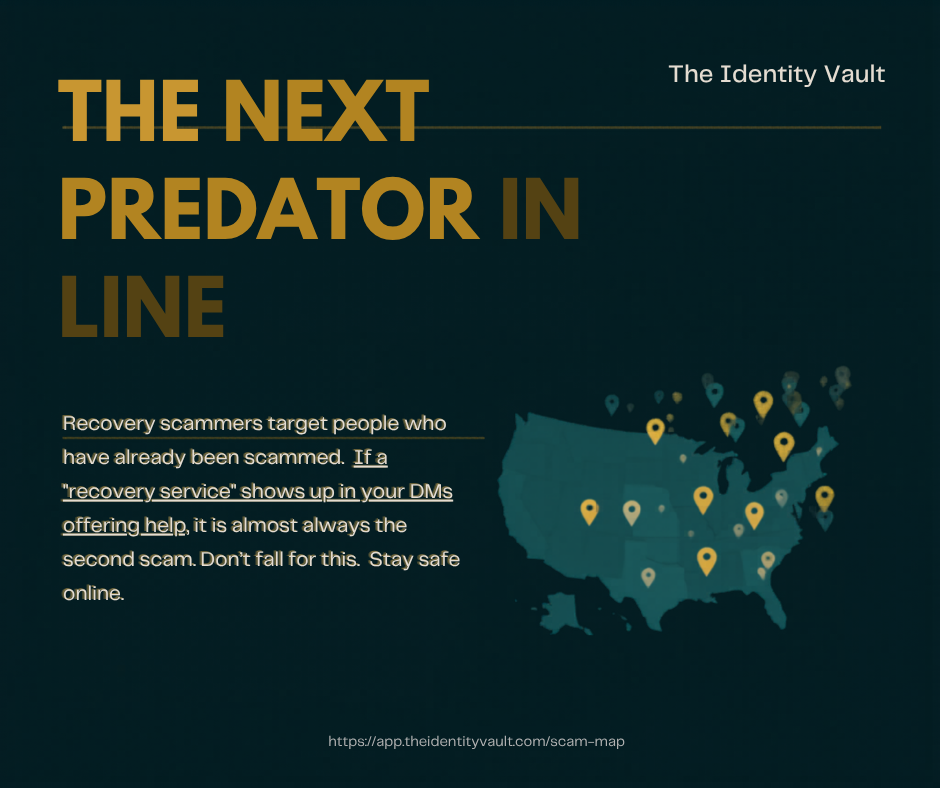
The Next Predator In Line
One of the cruelest second scams happening on Facebook right now. Learn the warning signs, the red flags, and what to do instead.

You finally worked up the courage to say it out loud, to share what happened to you. After looking for the right Facebook group, you thought out your words carefully, typed an emotional message, and shared a very personal and embarrassing detail about your life. I got scammed. What you do not know yet is that you are about to walk into a Facebook recovery group scam, where the next predator is already waiting for your message.
It is amazing how fast a stranger can slide into your DMs. A kind word. Maybe a sympathetic shoulder to lean on. This person knows exactly what to say, and they make you feel safe in this moment of vulnerability.
They mention a friend who was also scammed and suffered a larger loss than you did. Somehow that friend was able to recover every dollar. If you want, this person will help you start the same recovery process. A feeling of relief sweeps over you. But instead of recovery, this is where the second scam happens. It is called the Facebook recovery group scam, and it is one of the fastest growing fraud tactics on social media today.
That DM was not a coincidence. It was the start of one of the cruelest scams happening on the internet right now. A Facebook recovery group scam targets people during their lowest moment, when shame, hope, and despair are running hand in hand. This scam works because it is what every fraud victim is looking for. A way out.
30%
of scam victims say it started on social media
$2.1B
reported lost to social media scams in 2025
8x
jump in social media scam losses since 2020
Source: Federal Trade Commission, April 2026 data.
How the Second Scam Finds You
The first scam takes your money, but the second scam steals all the trust you have in humanity. So how does this happen a second time?
Imagine you were just involved in a fake job scam and you lost $3,400. Money you could not afford to lose. Anger sets in fast because that money is gone. Embarrassment follows because you fell for the scam. Then comes the desperate longing to make sure this never happens to someone else. So what do you do? The same thing almost everyone does. You go to social media and search Facebook for groups with words like scam survivors, scam recovery, or romance scam victims. Finally, a safe space. A space where you can share your story and hopefully educate someone else with your post.
What happens next is like a script out of a bad rom-com, and it goes something like this.
The DM arrives within minutes
Their profile picture is warm and gives off trustworthy vibes. Maybe a grandmother in her garden, or a man in a suit who looks like a banker. They send you a warm message. Wording varies, but the outline is always the same.
So sorry this happened to you. The same thing happened to my sister. She was so lucky to find an incredible recovery specialist who got her money back in two weeks. Would you like me to get their contact information for you?
You are instantly flooded with relief that you will be able to put this horrible experience behind you once and for all. The problem is, you did not seek out a recovery service. They sought you out. According to the FBI, if someone contacts you first, that alone is a major warning sign of a recovery scam. Legitimate agencies do not cold-call or message fraud victims on social media. If you want to see what real victims are reporting from real DMs like this one, check our community scam map.
The group itself may be a trap
Here is the scariest part of the whole story. The group you joined for support, the group you poured your heart out to about one of the most embarrassing and shameful experiences of your life, exists for the sole purpose of harvesting scam victims. Some of these groups are built by scammers to hunt for their next victim. They are seeded with fake testimonials about miraculous recoveries. The admins are not scam survivors. They are the people who took your money in the first place.
Guess what? You do end up on a special list. But it is not a good list. It is called the sucker list. Once you appear on one, your contact information gets sold and resold between criminal networks. This is why the calls and messages keep coming long after you thought the scam was over.
Free Download
Get the Basic 10-Step Lockdown Checklist
The basic PDF every person should have. 10 specific steps to lock down your credit, your accounts, your phone, and your identity. Save it. Print it. Share it with family.
No spam. Unsubscribe anytime. We never sell your data.
The fake success stories
As you look through the groups, you see posts that look like good news. Someone shares a screenshot of money returned to their account. Another person thanks a specific contact by name. A third voices skepticism at first, but the process was easy and went quickly, and now they have all of their savings back.
Unfortunately, those posts have been planted by the same scammers running the operation. The scheme is designed to convince you that this time will be different. You will not be the next victim. Instead, you will be the next success story. None of that is true. There are no recovery services here. The only thing coming next is another withdrawal from your account.
Why the Facebook Recovery Group Scam Works on Smart People
This part is worth reading twice. A Facebook recovery group scam does not work because the victim is gullible. It works because the victim is human.
When you have just lost money to fraud, three things are happening inside you at once. Shame, because you cannot believe you fell for it. Hope, because you want this not to be real. Urgency, because every hour feels like your money is getting further and further away. A recovery scammer is fluent in all three of these emotions and how to exploit them to the fullest. They offer absolution for the shame. A path to recover your money, which feeds the hope. A deadline to settle the urgency.
So here is the truth nobody tells you. People who lost money once are statistically more likely to lose money a second time. Not because something is wrong with them. Because the criminal economy is organized around finding them again. You are not gullible. Unfortunately, they are hunting you.
The Red Flags of a Recovery Scam That Should Stop You Cold
If a person or company offering to recover your money does any of these things, walk away.
- They contacted you first. Real investigators do not cold-DM you on Facebook or send unsolicited emails.
- An upfront fee is demanded. Retainer, processing fee, administrative charge, tax, crypto gas fee. Different names, same trick.
- Your Social Security number, bank login, or card numbers are requested. No legitimate recovery process needs this from a stranger.
- A fast or guaranteed recovery is promised. Real recovery is slow, uncertain, and usually free through official channels.
- Payment is demanded by gift card, wire, cryptocurrency, or peer-to-peer app. These payment methods are untraceable. That is the point.
- Urgency or pressure is used. “We can only act if you send the fee today” is a script, not a deadline.
- They claim to be from the FBI, FTC, IC3, or a real law firm. Federal agencies do not call or message asking for fees. The FBI has specifically warned about people impersonating its Internet Crime Complaint Center.
What to Actually Do After You Have Been Scammed
Unfortunately, this is the hardest part to hear. The honest truth is once the money has been moved through a wire, a crypto wallet, or an overseas account, the odds of getting it back are slim. But there are real free steps you can take to protect yourself from further loss and give law enforcement what they need to chase down the people responsible. Do the following list in order.
The first 24 hours after a scam
- Stop talking to the scammer. Do not threaten them. Do not try to get the money back yourself. Screenshot everything first, then block.
- Call your bank or card issuer immediately. Use the number on the back of your card, not a number from a text. Tell them this was fraud. Ask about a chargeback, a wire recall, or freezing the account if your information was exposed.
- Change passwords on every account the scammer touched or might have learned about. Email first, then financial accounts, then anything else important.
- Report the scam at ReportFraud.ftc.gov. This feeds the FTC database that helps law enforcement track scam patterns nationwide.
- If your identity was used, also report at IdentityTheft.gov. This generates a recovery plan and creates a federal record you may need for disputes.
- File a complaint with the FBI at IC3.gov. Especially important for losses over $1,000 or anything involving wire transfers or crypto.
- Place a fraud alert or credit freeze with all three bureaus. Free. Takes minutes. Stops new accounts from being opened in your name.
If those seven steps feel overwhelming when you are already in shock, that is normal. Our free Basic 10-Step Lockdown Checklist covers the basics every person should have in place before fraud ever finds them.
Protecting Yourself From the Second Scam
If you have already been scammed, assume your information is on a sucker list. The follow-up attempts will arrive by DM or email, by text or phone call from numbers that can sometimes look local. Here are the steps you should take to secure your personal identity vault.
Talk to one trusted person
Shame is what keeps people silent, and silence is what scammers count on. So pick one person you trust. Tell them what happened. Ask them to be your sounding board for any message or call that feels urgent over the next 90 days. Two sets of eyes catch what one set will miss when you are tired or upset.
Lock down your social media
Set your Facebook profile to friends-only. Turn off the option that allows people you do not know to message you. Review your groups, especially any you joined while looking for help, and leave the ones full of cold DM offers. You do not owe anyone an explanation for leaving.
Be skeptical of every unsolicited message
For the next several months, treat any unexpected message about your case, your refund, your money, or your identity as a scam until you prove otherwise. If you did not initiate the contact, you do not engage with it. Not sure whether something is real? The safest move is to hang up or close the message and call the agency or company yourself, using a number you find independently.
Independent verification
But what happens if you cannot find the number to independently verify? These scams are getting so sophisticated that scammers are now creating multilayer businesses, complete with letterhead, business websites, business email addresses, and even the names of actual people who are licensed with the state so they can provide credentials to their victims. When the scam looks real all the way down to the paperwork, the rule changes. Slow down. Walk away from the message or the call for at least 24 hours. Tell someone you trust. Then look up the licensing board, the state attorney general, or the federal agency directly and start your verification there, not from anything the scammer gave you.
You are not alone in this
This is exactly why we built The Identity Vault. Scammers prey on you being alone and emotional. They know there is no scam detection network out there, no real place for victims to come together and learn from each other.
The Identity Vault is different from a Facebook group. Everyone can join, but only with one verified account. People can only report a single instance of the same scam. There is no platform for scammers to have a voice. No DMs sitting in your inbox. No social media posts from a stranger touting how their great aunt Mildred recovered every dollar she lost. What we built is a platform for education and resources, powered by the people who have lived it.
Our community scam map lets real people report what is happening in their town, on their phone, in their inbox, so the rest of us can recognize the pattern before it lands on us. If someone has reached out to you with a “business” that feels off, check the map. If you have already been targeted, add your story. This is how we take back what scammers are stealing from us. We do this one report at a time, one person at a time. Verified trust in each other.
A note about reporting these groups
If you find a Facebook group that looks like a recovery scam operation, report it to Meta directly. Document the group name, the admin profiles, and any DMs you received. You can also report the group at ReportFraud.ftc.gov. Every report helps shut down the next recovery scam before it lands on someone else.
The Truth We Do Not Say Often Enough
Most stolen money does not come back. I am sorry I had to put that into writing, but it is true. I wish I could tell you that one phone call, a form on the correct website, or a specialist with the right contacts could undo what has happened. For a small number of cases, especially those caught within hours, partial recovery is possible. In most cases, though, the money is gone the moment it leaves your account.
So what can we do? We can stop the bleeding. We can keep the second scam from landing. We can take the information the criminals already have and make it useless to them. Real protection looks like this. It does not cost a recovery fee.
The Basic 10-Step Lockdown Checklist
A free printable PDF with the 10 basic steps to lock down your identity, protect your credit, and know exactly where to report fraud. Save it. Print it. Share it with family. We will email it the moment you sign up.
Get the Free ChecklistIf You Are Reading This for Someone You Love
If you are here because a parent, a friend, or a family member just told you they were scammed, the most important thing you can do right now is not lecture them. They already know. The shame is already there. What they need is a calm voice. A glass of water. Someone to sit beside them while they make the seven calls above.
Do not let them respond to any new messages or calls about the scam without you in the room. The recovery scammers are coming. You are the person who can keep the door closed. Check our community scam map first to see if other victims have reported the same pattern.
Before You Go
Help us help the next person
Sign up and we will send you new scam alerts, walkthroughs, and protection guides as soon as they go live. Forward them to anyone who needs a heads up.
No spam. Unsubscribe anytime. We never sell your data.
Together we will create a community that empowers individuals to stay one step ahead of the scammers.
Let’s take back what scammers are stealing from us. Trust in each other.
Leave a Reply