

Key Takeaways
- There is a public, searchable database for almost every consumer decision people make: restaurants, hotels, vacation rentals, used cars, employers, contractors, doctors. No such database exists for scams.
- That gap is why scammers keep winning. By the time a federal investigation publishes a press release, the same script has already moved through three more states.
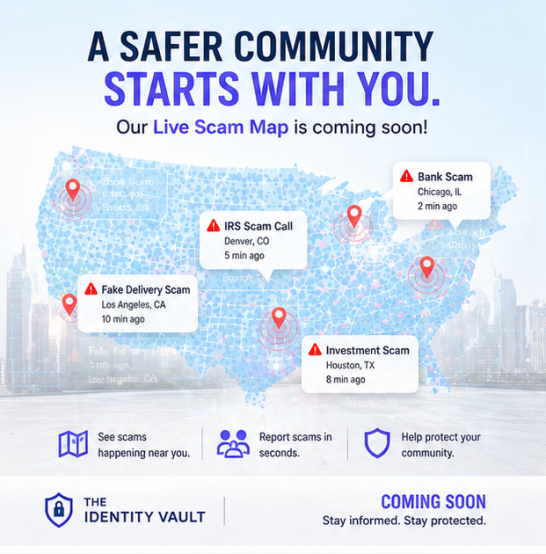
- The Identity Vault is being built to close that gap, starting with two products: the Scam Map (the verification database that should already exist) and the Lockdown platform (what to do once you confirm something is real).
- Both run on real people, verified accounts, and zero placeholder data. The whole company is built around the idea that the only thing scammers cannot survive is a population that warns each other in time.
- Join the waitlist and you’ll be one of the first people in when both launch.
In This Article
- There’s a database for everything except the thing that matters
- When I got scammed, I had nowhere to look
- Why this gap exists (and why it’s everyone’s problem)
- What the Identity Vault is building
- Will this actually work?
- The scam database, in plain English
- The Lockdown platform, in plain English
- What to do until the Vault is live
- Join the waitlist
to U.S. fraud in 2024
actually report it
for consumer scams
There is a public database for almost every consumer decision an American makes. Restaurants on Yelp. Hotels on TripAdvisor. Vacation rentals on Airbnb. Used cars on Carfax. Employers on Glassdoor. Doctors on Healthgrades. Contractors on Angi. Every meaningful purchase is backed up by reviews from real people. Every one, that is, except whether the person calling you right now is a scammer. There is no scam database for that.
Think about what that means in practice. Your phone rings. Someone says they’re calling from your bank’s fraud department about a suspicious charge. They sound official. They have your name. They want to verify a few things to make sure your account is safe. You feel that flicker in your stomach that says something is off. You want to check.
Where do you go?
There’s a database for everything except the thing that matters
The honest answer is: nowhere. No Yelp for scammers. No TripAdvisor for fraudulent companies. No public, searchable database anywhere where you can type in a phone number, an email address, or a company name and find out in five seconds whether the person on the other end of the line is real. The closest thing we have is a Google search that turns up forum posts from 2017, three affiliate sites trying to sell you something, and one Reddit thread with no clear answer.
Think about how absurd that is. Americans lose more than $12 billion a year to scams that get reported, and probably ten times that amount to scams that don’t. That makes it the single most common consumer crime in the country. And the only consumer crime that has no public information system.
Contractors have license registries. Doctors have malpractice histories. Restaurants get cited for health violations and the citations are public. Airlines have safety records anyone can pull up. Even your dentist has a Yelp page. But the person currently calling your mother claiming to be from Medicare? Nothing. Not the phone number. Not the company name. Not the script they’re using. Nothing at all.
When I got scammed, I had nowhere to look
I am not writing this as somebody who studied scams from a distance. I am writing it as somebody who got scammed, who tried to verify what was happening as it was happening, and who came up empty everywhere I looked.
Google was the first stop. The phone number, the company name, the email address, every combination of those three together. Then it was off to whatever review sites and consumer warning forums I could think of, looking for any official source that would tell me whether what I was looking at was real or not. The search results were mostly garbage. By the time I figured out what had actually happened, the damage was done.
What I kept thinking afterward was: how is this still the situation in 2026? We can search every other category of consumer information instantly. We’ve built infrastructure for every minor decision a person makes. But for the moment that actually costs people their savings, their retirement, sometimes their sense of safety in their own home, there is nothing. And that gap is what I started building this company to close.
Get on the waitlist before the doors open
The Identity Vault Scam Map and the Lockdown platform are both launching this year. Get on the waitlist now and you’ll be one of the first people in.
Join the waitlist →Why this gap exists (and why it’s everyone’s problem)
The gap is not because the data does not exist. It absolutely exists. The Federal Trade Commission collects scam reports through Consumer Sentinel, a database that more than 2,800 federal, state, and local law enforcement agencies have access to. The FBI collects internet fraud reports through IC3. The U.S. Postal Inspection Service tracks mail fraud. State attorneys general have their own systems. Local police departments file their own reports.
The data is there. The catch is that it’s walled off, designed for investigators rather than for the public, and almost never makes it back to the everyday person who needs it most. By the time a federal investigation produces a public press release, the same script has already moved through three more states.
And that’s the heart of why scammers keep winning. They count on the fact that information moves slowly through official channels and that there is no public, real-time alternative. They run a script in Iowa on Tuesday, take it to Missouri on Wednesday, then Kansas on Thursday. The phone number rotates, but the wording barely changes, because the wording is what works. The only way that pattern stops is if the people getting hit can warn the people who are about to get hit, faster than the scammers can move.
Here’s what a scam database actually does. Not catch the scammer afterward. Warn the next person before. A real scam database is the missing piece that turns reporting into prevention.
What the Identity Vault is building
The Identity Vault is being built around one premise: every consumer scam-protection problem in this country can be traced back to two missing pieces. People cannot easily find out what is real. And once they find out something is not real, they have no idea what to do next.
So we are building two things, and they are designed to work together.
The first is the Scam Map, which is the public, searchable, real-time scam database that should already exist. Every consumer scam-protection company on the market today either ignores this gap entirely or tries to fill it with a generic “free scam alerts” newsletter that nobody reads. Our scam database is built differently. Real people, verified accounts, structured reports, organized by location and by scam type, searchable the way you’d search any other database.
The second is the Lockdown platform, which is the step-by-step guided system for protecting your identity once you know what to do. It walks regular people through every action that matters: freezing credit at all four bureaus, locking down your Social Security account, securing your phone carrier so nobody can SIM-swap you, and dozens of other steps that most people have never heard of and would not know how to do on their own.
Together, those two products form what I think is the first end-to-end consumer scam-protection system that actually works the way modern people search for and act on information. The Scam Map answers the question “is this real?” The Lockdown platform answers the question “now what do I do?”
Will this actually work?
I get this question a lot, and the honest answer has two parts. Yes, with caveats. Let me explain both.
The case for yes is straightforward. Federal investigations are slow because they have to be. They are building criminal cases that have to hold up in court, and that deliberate pace is a feature, not a bug, of how law enforcement works. The cost of that pace is that the warning never reaches the next victim in time. The scammer has already moved on by the time a press release goes out.
A real-time, public database flips that timeline completely. The warning travels at the speed of community reporting, not the speed of federal prosecution. A single verified report posted on a Tuesday afternoon can warn somebody’s grandmother by Tuesday evening. What you’re looking at is a fundamental shift in how scam information moves through the country, and it’s the part of the system that has been missing for decades.
The network-effect argument is the other piece. Every person who reports adds to the dataset. As the dataset grows, the database becomes more useful. As it becomes more useful, more people use it. As more people use it, more people contribute. Yelp, Glassdoor, TripAdvisor, Carfax: every one of those products started small and got powerful because the participation curve compounded. A scam database can work exactly the same way if the verification model holds.
Now the caveats, because I don’t want to oversell anything. A scam database does not prevent scams from being attempted. Scammers will keep dialing. New scripts will keep being invented. The database does not shut down call centers overseas or stop crypto wallet drains. What it does do is dramatically reduce the success rate of scams that have already been documented somewhere. If your mom can search a phone number and see that it has been reported forty-seven times in the last thirty days as an IRS impersonation, she hangs up. The attempt happened, but it didn’t work. And that’s the win.
The other caveat is that the people most vulnerable to scams (elderly relatives, isolated adults, anyone less comfortable with technology) are also the least likely to think to check a database before answering a phone call. Which is exactly why the Identity Vault has the Lockdown platform alongside the map. The map helps the people who think to look. The Lockdown platform protects the people who don’t, by making sure their accounts are locked down before the call ever comes in. The two products are designed to work together precisely because no single product can solve this problem on its own.
The scam database, in plain English
You’ll go to a website. Type in your zip code, or a phone number, or a company name, or part of a script that someone said to you on a call. The map shows you whether anyone else has reported the same thing, where it was reported, when it happened, and how the scam came at the people it hit (a phone call, a text, an email, a knock at the door, the mail). If enough people report the same pattern, the system flags it as Verified, meaning it’s confirmed with multiple corroborating reports behind it.
That’s the consumer side of it. On the reporting side, anyone who got hit (or almost got hit) can submit a report from a free, verified account. Email and phone number are required for verification, and the system limits one account per email and one per phone number. That verification step is the whole reason the data is trustworthy. Without it, the map would be useless within a week. With it, every pin on the map is a real person reporting a real thing.
The reporting form itself is short. We never ask for an SSN, a date of birth, or anything else that could be used against you. What we collect about you is for verifying you’re a real person, and it stays private. What we collect about the scam is what gets shared with everyone else.
The Lockdown platform, in plain English
Most people have no idea how to protect their identity. They’ve heard they should “freeze their credit” but don’t know there are four credit bureaus, not three. ChexSystems is a name they’ve probably never encountered. The IRS issues something called an Identity Protection PIN; almost nobody knows about it. Phone carriers offer SIM-swap locks; most customers have never been told. None of this is anyone’s fault, exactly. Nobody has put the whole list in one place and walked regular people through it.
That’s what the Lockdown platform does. Think of it as a guided, step-by-step system that takes you through every action that actually protects your identity in this country. Each step is a short walkthrough with screenshots, the exact website to visit, what to click, what to expect, and what to do if something goes wrong. You can do the whole thing in an afternoon, or one step at a time over a few weekends. Either way, when you’re done, your identity is genuinely locked down in a way that almost no American’s identity currently is.
The Lockdown platform and the Scam Map are designed to work together. The Map answers “is this real?” The Lockdown platform answers “what do I do next?” Together they cover the full lifecycle of how a scam actually plays out in real life.
What to do until the Vault is live
While we are building, here are the resources that exist today. None of them are the database I just described. But they are the best we have right now, and bookmarking this section is worth your time.
Where to report a scam today
FTC — General Fraud & Scams
Use for any scam attempt, even if you didn’t lose money. Phone scams, robocalls, fake refunds, romance scams, imposter scams. The FTC feeds reports into Consumer Sentinel.
reportfraud.ftc.gov →FTC — Identity Theft Recovery
Use this specific portal if your name, Social Security number, or financial accounts were used. You’ll get a recovery plan and a formal Identity Theft Report.
identitytheft.gov →FBI — Internet Crime (IC3)
Use for online fraud, ransomware, business email compromise, cryptocurrency scams, and anything where the attack came through the internet.
ic3.gov →U.S. Postal Inspection Service
Use for any scam involving the U.S. Mail. Fake checks, stolen mail, package theft, mailed sweepstakes scams.
uspis.gov/report →AARP Fraud Watch Helpline
Free help line staffed by trained fraud specialists. Especially valuable for older adults or anyone supporting an elderly parent. Call 877-908-3360.
aarp.org/money/scams-fraud/helpline →Your Local Police Department
File a local report any time you’ve lost money or had your identity used. You’ll need the report number for your bank, your insurance, and any future dispute. Use the non-emergency line.
Search “[your city] police non-emergency” →Bookmark this section, send it to your parents, send it to your kids. Until the Vault is live, this is the patchwork of agencies that will catch what you report. Use it.
⚠ Reporting Still Matters
Even when the Scam Map is live, please continue reporting to federal agencies as well. Federal reporting is what triggers federal investigations and shuts down the operations behind these scams. The Map is what warns your neighbors in the meantime. Both jobs are necessary.
Join the waitlist
Both products are in active development right now and launching this year. The Scam Map is closer; the Lockdown platform is right behind it. If you want to be one of the first people in when each one goes live, the waitlist is the way to make sure I email you.
One signup gets you on both early-access lists. No newsletter, no marketing emails, no upsell sequences in between. You’ll hear from me twice: once when the Scam Map opens, and once when the Lockdown platform opens. Nothing else.
Be First in Line
The Scam Map and the Lockdown platform are launching this year. The waitlist is open now. One signup, both notifications, no nonsense in between.
Leave a Reply