
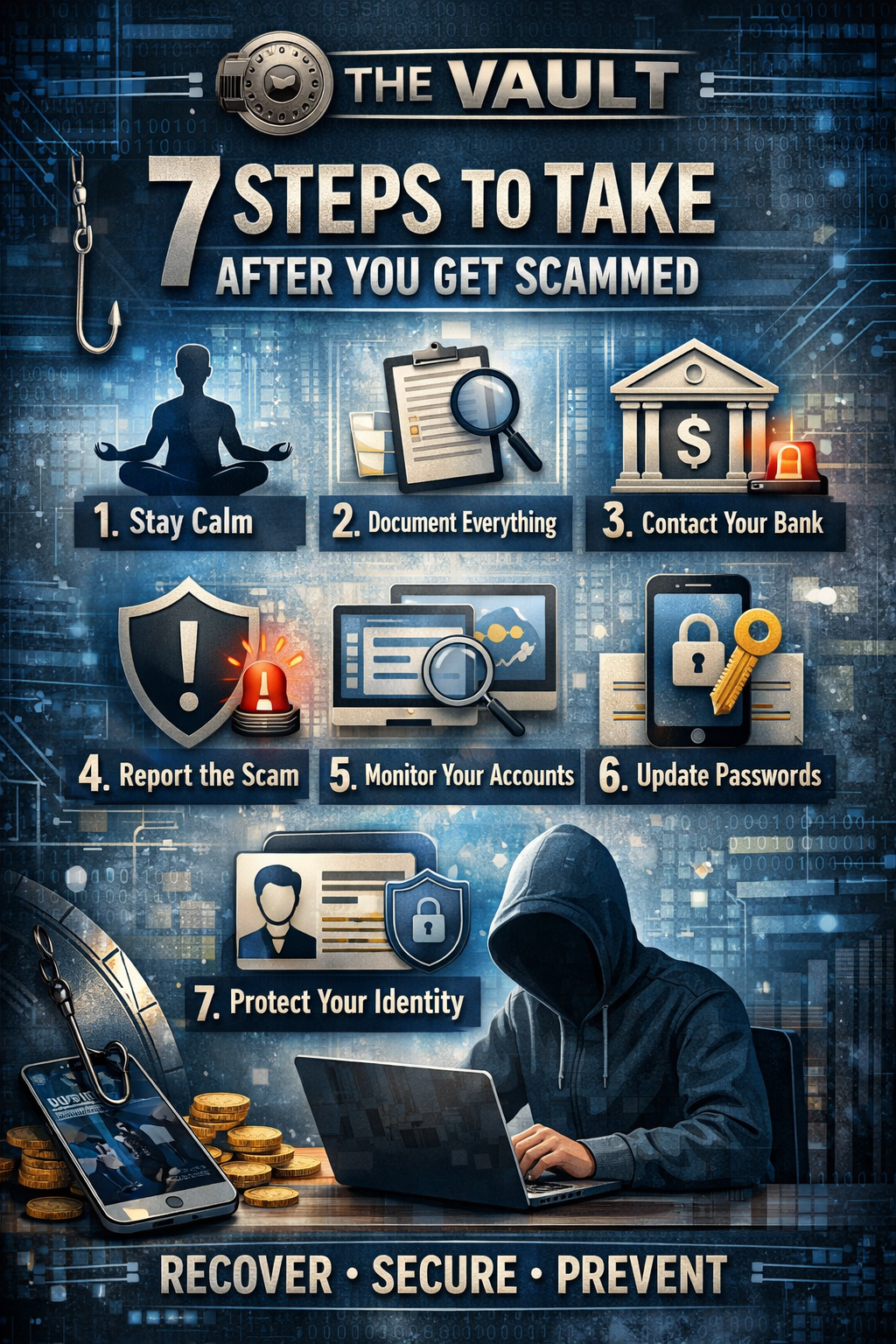

Key Takeaways
- The first 60 minutes after a scam are the most critical — specific actions taken immediately can mean the difference between recovering your money and losing it permanently
- Call your bank first, before doing anything else — wire transfers and gift card scams have a narrow recovery window that closes fast
- You must report to three places: your bank, the FTC at ReportFraud.ftc.gov, and your local police — each serves a different purpose and all three matter
- If you gave out personal information, freeze your credit at all four bureaus within 24 hours — this single action prevents the most financially devastating identity theft scenarios
- Shame is normal but dangerous — the longer you wait to report, the more options you lose. Being scammed does not mean you are stupid. It means you encountered a professional criminal.
- Recovery is possible. People get money back, accounts restored, and identities protected — but it requires moving fast and knowing the right steps
In This Guide
- The First 60 Minutes: What to Do Right Now
- Step 1: Call Your Bank Before Anything Else
- Different Scam Types, Different Responses
- Who to Report To — And Why Each One Matters
- If You Gave Out Personal Information
- The Road to Financial Recovery
- The Part Nobody Talks About: The Emotional Recovery
- Making Sure It Never Happens Again
What Happens in the First 60 Minutes Matters Most
Your heart is racing. Maybe you just wired money, or handed your credit card number to someone who sounded completely legitimate, or clicked a link and watched your screen go dark. Maybe you gave your Social Security number to someone claiming to be from Medicare — and then something felt wrong.
If you are reading this, you think you were just scammed. And you want to know what to do right now, in the next hour, before things get worse.
Fortunately, this guide was written for exactly this moment. Not for later. Right now.
Here is the most important thing to know before you read anything else: you are not stupid. The people who run these operations are professionals. These operations study psychology, run scripts refined over thousands of calls, and know exactly which words trigger panic, which trigger trust, and which shut down critical thinking. Some of them run organizations with dozens of employees, training programs, and quality control. You were targeted by people who do this full time.
Consequently, what happens next depends on how fast you move. Let’s go.
⚡ Do These Right Now — Before Reading Further
- Call your bank immediately — tell them you were scammed and need to stop or reverse a transaction
- Do not hang up on the bank to answer another call — scammers sometimes call back posing as your bank’s fraud department
- Screenshot everything — the website, the email, any phone numbers, any messages. Evidence disappears fast
- Do not send any more money — scammers often call back claiming they can help you recover what you lost, for a fee
The First 60 Minutes: What to Do Right Now
Time works against you after a scam. Wire transfers can be recalled within a narrow window. Fraudulent credit card charges are far easier to dispute in the first 24 hours than after 30 days. Credit freezes prevent secondary fraud that often comes in the days after a scammer gets your personal information.
The instinct many people have is to sit with the shock first — to process what happened before taking action. That instinct makes complete sense emotionally. But financially, it is costly. The steps in this guide are ordered specifically by time sensitivity.
Step 1: Call Your Bank Before Anything Else
If money moved — a wire transfer, a bank transfer, a Zelle payment, a credit card charge — your first call needs to be to your bank. Not the police. Not your family. Your bank first.
Here is what to say when they answer:
“I need to speak to your fraud department immediately. I believe I was the victim of a scam and I need to attempt to stop or reverse a transaction that just happened.”
Keep saying this until you reach someone in fraud. Do not let them route you to general customer service. If the first person you talk to cannot help, ask for a supervisor.
Wire transfers — call within hours, not days
Banks can sometimes recall wire transfers if acted on quickly enough — but this window is measured in hours, not days. The sooner you call, the better your odds. Banks that receive fraudulent wires are increasingly cooperative about returns when fraud is clearly documented.
Credit and debit card charges — dispute immediately
Credit card fraud protections are strong in the US. Debit card protections are weaker but still exist. Call the number on the back of the card, say you are disputing a fraudulent charge, and request a chargeback. Do this today. Do not wait for your statement to arrive.
Zelle, Venmo, Cash App, PayPal — act immediately
Peer-to-peer payment apps offer limited fraud protection compared to credit cards — but reporting immediately and opening a dispute is still worth doing. Contact both the app and your bank. Some banks have policies that cover Zelle fraud when reported quickly.
Gift cards — call the card issuer directly
This is the hardest to recover from. Scammers redeem gift cards within minutes. But it is worth calling the gift card company immediately (the number is on the back of the card) and reporting fraud. Some companies will block unredeemed balances. Get a police report number to support the claim.
Different Scam Types, Different Responses
Not every scam requires the same immediate response. Here is what to prioritize based on what happened to you:
If you gave someone remote access to your computer
Disconnect from the internet immediately — turn off WiFi or unplug the ethernet cable. The scammer may still be inside your machine. Do not reconnect until a trusted technician has reviewed the computer for malware, remote access tools, and keyloggers. Change every password from a different device before reconnecting the compromised computer. Your banking credentials, email accounts, and stored passwords may have been harvested.
If you clicked a suspicious link or downloaded an attachment
Run a malware scan immediately. If you do not have security software, use Malwarebytes — there is a free version that is highly effective for an initial scan. Change your email password and any accounts where you use the same password. Enable two-factor authentication on your email account first — email is the master key to everything else.
If you gave out your Social Security number
Go directly to the identity theft section below. Freeze your credit at all four bureaus today. File a report at IdentityTheft.gov. Monitor your credit reports for new accounts you did not open. This is serious but very manageable if you act quickly.
If you sent money to a romance scammer
There is a painful reality here worth naming: the person you thought you were building a relationship with does not exist. In a romance scam, the photos were stolen and the story was manufactured — but the feelings were real on your side and completely fabricated on theirs. This is not a reflection of your intelligence or your worth as a person. Romance scams are specifically designed to exploit trust and love — the best qualities you have.
Cut off all contact immediately, on every platform. Do not respond to follow-up messages, especially any offering to help you recover your money — this is a common secondary scam targeting the same victim. Report the profile to the platform where you met them, and report to the FTC.
Who to Report To — And Why Each One Matters
Reporting a scam is not just about getting your money back. Every report you file makes the next person harder to scam. Here are the three places to report, and why each one matters:
1. The FTC — ReportFraud.ftc.gov
This is the most important report you can file. The Federal Trade Commission aggregates fraud reports to identify patterns, pursue enforcement actions against scam operations, and issue consumer warnings. Your report becomes part of the data that helps the FTC identify and shut down large-scale operations. It also creates an official record that your bank, insurance company, or credit bureau may request when you dispute charges or file claims.
The form takes about ten minutes. Be as specific as possible — phone numbers, website URLs, the exact words they used, timestamps. Details matter.
2. Your Local Police Department
You may be told that there is little local law enforcement can do about a phone scam operating from another country. That is often true. File the report anyway. The police report number is required by many banks when processing fraud claims. It is required by some insurance policies. And it contributes to local data that helps law enforcement recognize patterns and escalate cases to federal agencies.
3. The FBI’s Internet Crime Complaint Center — IC3.gov
If the scam involved the internet, email, or any digital component, file a complaint with IC3. The FBI uses these complaints to pursue criminal organizations. Large scam operations often have victims in multiple states, and IC3 complaints are how the FBI builds cases large enough to prosecute.
If You Gave Out Personal Information
This section applies if you gave out any of the following: your Social Security number, Medicare or Medicaid ID number, date of birth combined with your address, driver’s license number, bank account or routing number, or login credentials for any financial account.
These are the building blocks of identity theft. With this information, a scammer can open credit cards in your name, file fraudulent tax returns, apply for loans, redirect your Social Security benefits, and create a financial trail that takes months or years to fully clean up.
Here is what to do — in this order:
Freeze your credit at all four bureaus today. Freeze your credit at all four bureaus — visit Equifax, Experian, TransUnion, and Innovis — all free and all essential. Each one allows you to place a security freeze for free. This prevents any new credit accounts from being opened in your name — even if someone has your SSN. A freeze does not affect your existing accounts or your credit score. It is the single most powerful preventive step available to you.
Go to IdentityTheft.gov. This is the FTC’s dedicated identity theft resource. It will walk you through a personalized recovery plan based on exactly what information was compromised. It generates template letters for disputing fraudulent accounts, contacting credit bureaus, and notifying government agencies.
Place a fraud alert with one bureau. Contact any one of the three major credit bureaus and ask them to place a 90-day fraud alert on your file. That bureau is required to notify the other two. A fraud alert requires creditors to verify your identity before opening new accounts — an added layer on top of the freeze.
Check your credit reports at AnnualCreditReport.com. You are entitled to one free report per bureau per year. Review each one carefully for accounts you do not recognize. Dispute anything unfamiliar directly with the bureau and with the creditor that opened the account.
The Road to Financial Recovery
The honest answer about financial recovery from scams is that it varies enormously depending on what payment method was used and how quickly you acted. Here is a realistic picture:
Credit card charges are the most recoverable. Federal law gives credit card holders strong protections against fraud. Dispute the charge with your card issuer, reference your police report, and in most cases the charge will be reversed pending investigation.
Bank wire transfers are harder, but not impossible. If you acted within 24–48 hours, there is a real chance the wire can be recalled — especially if the receiving bank has not yet processed or disbursed the funds. Banks have financial crimes departments that handle exactly this. Be persistent. Ask for a supervisor. Reference your FTC and police report numbers.
Peer-to-peer payments (Zelle, Venmo, Cash App) are the most difficult. These platforms were designed for fast, convenient transfers between people who trust each other. The fraud protections are limited. That said, file disputes with both the app and your bank. Some banks have quietly expanded their Zelle fraud coverage in recent years.
Gift cards are the hardest. Scammers know this, which is why they ask for them. File a police report, contact the card issuer, and document everything — but manage your expectations about recovery here.
The Part Nobody Talks About: The Emotional Recovery
The financial steps in this guide are the practical response. But there is another dimension to being scammed that most resources skip entirely — and that silence makes it worse.
Being scammed feels like a violation. It feels like stupidity, even when you know intellectually that it was not. It often comes with grief — especially in romance scams, where a relationship you believed in turns out to have been entirely fabricated. It can shatter your sense of trust in yourself and in other people.
All of that is normal. All of it is real. And none of it means you are broken.
Research on scam victims consistently shows that the shame response — the internal narrative of “how could I be so stupid” — is the most damaging long-term consequence. It is also the thing that prevents people from reporting, from talking to their families, and from getting help. The shame serves only the scammer.
Talk to someone you trust. If the financial loss was significant or the emotional impact is lasting, talk to a professional. The AARP Fraud Network (1-877-908-3360) has counselors specifically trained to work with scam victims. You do not have to carry this alone.
Making Sure It Never Happens Again
You have just had one of the most effective scam-prevention education experiences available — painful as it was. People who have been scammed once, and who take the time to understand what happened, are significantly less likely to be scammed again.
Before you close this page, do these three things:
Freeze your credit — if you have not already done it as part of your recovery steps, do it now. Even if no personal information was compromised in this scam. It costs nothing. It takes 15 minutes. It permanently closes one of the most dangerous doors a scammer could walk through.
Download our free Identity Lock Checklist — 30 steps to lock down your identity, secure your accounts, and put early warning systems in place so that if anything happens again, you know about it immediately.
Set up a family safe word — especially if you have elderly parents. The grandparent scam, the emergency scam, and the impersonation scam all rely on you making a fast decision under pressure without consulting anyone. A family safe word that only real family members know destroys these scams instantly.
Lock Down Your Identity — Starting Right Now
Get the free 30-step Identity Lock Checklist. Freeze your credit, secure your accounts, and put the systems in place that make sure this never happens again.
If you are reading this in the immediate aftermath of a scam — take a breath. You found this guide. You are taking the right steps. That already puts you ahead of the majority of people this happens to, most of whom sit with the shame too long and lose options in the process.
You have everything you need right here. Start with the bank call. Move through the steps. And when the immediate crisis is behind you — give yourself grace. This happened to you. It does not define you.
Leave a Reply