

Inside the Experian FaceTime Scam: A First-Hand Account
It was a Saturday afternoon in late March, and what arrived in my house that day was an Experian FaceTime scam. My family was working outside. The phone rang, and the caller ID showed an unfamiliar Atlanta number, (678) 264-9839. I picked up.
The man on the other end had an Indian accent and a calm, professional tone. He asked if he could speak with Eric Jones. That’s my husband. I told him Eric was busy outside, and asked what this was about.
He said he was calling from Experian’s fraud monitoring department. They had detected a $1,100 charge on Eric’s Visa for a one-way plane ticket to Europe. Did I know about this purchase? Had Eric authorized it?
I told him no, we hadn’t authorized anything like that. My voice climbed. I told him we were on Social Security disability, that we couldn’t afford a $1,100 hit, that this would be devastating for our family. Over and over I asked him what to do.
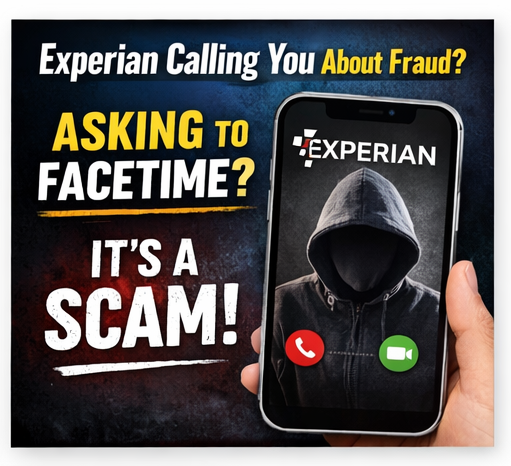
He stayed perfectly calm. Everything was going to be fine, he told me, that we had caught it in time, that he was here to help me secure the account. There was just one thing he needed me to do. He needed to FaceTime me so he could walk me through locking down my phone. And whatever I did, I could not hang up.
I declined the FaceTime. The call ended. Then I went back outside.
What I haven’t told you yet
I knew it was a scam from the moment he said the word Experian.
I run an identity protection company. The Experian FaceTime scam pattern is one of several I had studied in the previous six weeks, after surviving a much larger scam attempt that nearly cost my family $200,000. I know exactly what credit bureaus do and don’t do. So when this call came in, I wasn’t a panicked victim. I was someone collecting research material.
The crying. The disability story. The “what do I do, what do I do.” All of it was theater. I was doing what most people don’t get to do during a scam call. I was watching the script unfold live and taking notes.
Here is what I learned.
The opening line told me everything
The very first thing he said was that he was from Experian and that they had detected a fraudulent charge on Eric’s Visa. That single sentence is the whole reason I knew it was a scam before he finished his next breath.
Experian does not monitor your individual credit card transactions. That’s not what a credit bureau does. Experian tracks the open-account history that gets reported to them by lenders. They don’t see your purchases as they happen. They have no way to know that a $1,100 charge for a plane ticket was just made on Eric’s Visa. That information lives with the card issuer and the merchant, not with the credit bureau.
The only entities that monitor your transactions as they happen are your bank and your credit card company. Not Experian, not TransUnion, not Equifax. If anyone calls you claiming to be a credit bureau monitoring a specific charge, you are talking to a scammer. The premise of the call cannot be true.
This is one of the most useful patterns to memorize. The scam falls apart at the first sentence if you know what each company actually does.
The Visa-to-Mastercard switch
Now, here is where it got interesting.
The opening line was clear. He said Visa. Eric’s Visa, $1,100, plane ticket to Europe. I logged that detail. Then I started running my act. I cried. Then I asked questions on top of questions. I talked over him. The whole time I kept saying I didn’t understand, could he explain it again, what did this mean for my family, were we going to lose our house.
Somewhere in the chaos of my panicked questions, his story slipped. He started referring to the card as a Mastercard. Then back to Visa a moment later. Then Mastercard again.
He couldn’t keep his own script straight because I wouldn’t let him control the pace.
The card-name switch was not a clever manipulation tactic. It was a script falling apart under pressure. The scammer’s job is to control the rhythm of the call. The moment you take that rhythm away, the cracks show.
This matters for two reasons. First, if you ever notice a caller switching small details mid-conversation, that’s a signal you should trust. They’re working from a memorized script and they’ve lost their place. Second, if you do find yourself on a call you can’t immediately end, talking fast and asking lots of questions can actually destabilize the script. You don’t have to go full theater like I did. Just don’t let them set the pace.
The FaceTime ask
Once he had built up the urgency and gotten me asking for help, he made his move.
He told me he needed to FaceTime me. It was the only way he could walk me through locking down my phone, he said. Under no circumstances could I hang up. We needed to stay on the line and switch to video so he could guide me step by step.
No legitimate fraud department in the world will ever ask to FaceTime you. Not your bank. Not your credit card company. Not the credit bureaus. Not the IRS. Not Microsoft. Not anyone.
The reason scammers want you on FaceTime is simple. They want to see your screen. Once you accept the call and follow their instructions, the scammer can watch you type passwords. They can see verification codes appear in your text messages. They can guide you to settings you would never normally touch. Within ten minutes they can be inside your bank account, your email, or your Apple ID.
I declined the FaceTime request. I didn’t even open the FaceTime invitation. Even doing this for research, I had a small honest fear that just answering it could somehow be used against me. I trust my instinct on that, and I think other people should too. If you’re not sure whether something is safe, it isn’t. You don’t owe anyone a polite explanation. You can just decline.
Why I always answer the phone now
A few months ago, I would have let this call go to voicemail. Now I pick up almost every time, especially when I see an unfamiliar number.
The reason is The Identity Vault. I’m building a platform to help people protect themselves from scams, and the best material for that work comes from real scam calls. Every time I let a scammer run their script on me, I learn something I can use to teach others. The exact tactics they use, the way the script breaks under pressure, the specific phrases that signal the next escalation. None of this is in a textbook. You only get it from listening.
This is not advice for everyone. If you are not comfortable engaging with scammers, don’t. Hang up immediately. There’s no shame in that. None of this is meant to encourage you to bait scammers. My only goal is to share what I’m seeing so that you don’t have to.
The Hard Rock connection
One detail of this call lined up exactly with the Hard Rock scam I survived a few months earlier. The caller asked for Eric Jones. Not me. They had my phone number, but they wanted to speak with Eric.
This is the same pattern that played out for six weeks during the Hard Rock stock sale scam. They reached me on my phone but kept asking for Eric. They had Eric’s name and Eric’s history, but somehow my number. That’s not coincidence. It tells me that whoever is selling scammer-target lists has Eric’s details bundled with my contact information. Either we share an old account that linked our records, or one of the data brokers we’ve never heard of has us cross-referenced incorrectly.
If you have ever had this happen, where someone asks for your spouse but calls your phone, take it seriously. It means your household is on a list somewhere. That list is being sold and resold, and the next call you get may be from a different scammer using the same data.
The fix is to opt out of as many data broker sites as you can. Sites like Spokeo, WhitePages, BeenVerified, and dozens of others sell your household details to anyone who pays. Opting out takes time, but it cuts the number of scam calls you receive over the following months.
The number that called me
Number used in this Experian FaceTime scam
(678) 264-9839 — Atlanta area code, presented as Experian fraud monitoring. If you receive a call from this number, do not engage. The number may be spoofed and reused for other scams.
I’m publishing the number because scammers reuse infrastructure. The same phone numbers, scripts, and tactics get rotated through different victims. If you ever Google a number after a suspicious call, that search history is part of how we collectively start to recognize the patterns. Every documented scam call makes the next one harder to pull off.
If you’ve received a call from this number, leave a comment below or send an email. The more data points we have on each scam operation, the easier it is to map them.
What to do if a similar call comes in
You do not need to be polished. You don’t need a script. You don’t need to verify anything. You just need to know the rules.
The four sentences that mean it’s a scam
If a caller says any of the following, you can hang up immediately. There is no legitimate version of these requests.
First, anything about FaceTime, video chat, or screen sharing. Real fraud departments handle their work by phone or email. Video is never part of a real fraud workflow.
Second, any request to install an app. Especially anything called TeamViewer, AnyDesk, RemotePC, or any “security app” you have never heard of. These are remote access tools. Once installed, the person on the other end can see and control your device.
Third, a request to read back a verification code. Verification codes exist to protect you from people who are not you. Reading one to a caller is the same as handing over your account password.
Fourth, any mention of gift cards. No real company, no government agency, and no fraud team accepts gift cards as payment. If gift cards come up, you are talking to a scammer.
If you’re not sure, call the company yourself
Here’s the rule that matters more than any other. Never call the number a caller gives you. Never click a link in a text or email about fraud. Always look up the company’s real number yourself, using the back of your card, your account statement, or the company’s actual website typed directly into your browser.
For Experian specifically, the real fraud department number is (888) 397-3742. You can also visit experian.com/help for official contact information.
If you’ve already engaged with the call
If a similar call has happened to you and you accepted the FaceTime, installed something, gave verification information, or transferred money, you need to act today. Not tomorrow. Today.
The first 24 hours after a scam are the most important window for limiting the damage. We built a free, step-by-step recovery plan for exactly this scenario. It walks you through what to do in the first hour, the rest of day one, and the wind-down phase. No signup, no upsells.
Quick first steps
Place a fraud alert at one of the three big credit bureaus. You only need to call one. Federal law requires that bureau to notify the other two within 24 hours. Equifax, Experian, and TransUnion all offer free fraud alerts that last for one year.
Call your credit card companies and your bank. Use the number on the back of your card, never a number a caller gave you. Tell them what happened and ask them to flag your accounts for fraud monitoring.
If you installed any app the caller mentioned, delete it immediately. Then turn your phone off, turn it back on in airplane mode, and use a different device to change your passwords. The phone might still be compromised even after you delete the app.
Within 24 hours, you also want to place a credit freeze at all five major bureaus, not just three. The big three handle credit cards and loans. Innovis handles a fourth credit reporting layer that some lenders use. ChexSystems controls whether new bank accounts can be opened in your name. A fraud alert and a freeze can both stay active at the same time. They work together.
What I want you to take from this
The scammer who called me on that Saturday afternoon was working a script. He had a story (Experian fraud), a setup (Eric’s Visa, $1,100, Europe), an emotional hook (your husband’s account is at risk), and an escalation (FaceTime so I can lock down your phone). It was a polished, well-rehearsed routine.
And it broke the moment I refused to play along.
You do not need to be an identity theft researcher to break a scammer’s script. You just need to know that the premise is wrong. Credit bureaus do not monitor your transactions. Fraud departments do not FaceTime you. Real banks do not need you to install software, transfer money, or read back codes. The moment any of those things come up in a call, you have all the proof you need.
You can hang up. You don’t owe them an explanation. You don’t need to verify with anyone afterward. The request itself was the proof.
If you’ve been targeted, share what happened
Every scam I document on this blog comes from a real call I either received or was told about by someone who reached out. That’s how the pattern recognition gets built. If you’ve been called by (678) 264-9839 or any similar number claiming to be from a credit bureau, leave a comment below or send me a note. Your story may help the next person spot it faster.
I write about every scam I personally encounter, including the six-week Hard Rock stock sale scam I survived. If this story was useful, you can read the full Hard Rock series on the blog. The pattern recognition you build by reading other people’s stories is the single best protection against the next call you get.
Stay alert. Trust your instincts. And if anyone ever asks to FaceTime you about fraud, you already know what to do.
Lock down your identity tonight
The free 30-step Identity Lockdown Checklist walks you through every account you need to secure. The 24-Hour Response Plan gives you a step-by-step guide if you’ve already been targeted. Both are free.
Leave a Reply